Technologies Used
For Used Engine Oils
(High Vacuum Distillation Process)
High vacuum distillation is the core technology used in the recycling and re-refining of used engine oils. The process operates under high vacuum conditions, which significantly lowers the boiling points of the hydrocarbons and allows thermal separation at much lower temperatures, preventing oil degradation.
Key Features
Low-temperature separation: Vacuum levels typically reach 1–5 mbar, reducing the boiling point of heavy hydrocarbons and preventing cracking or burning.
High thermal efficiency: Heat is applied uniformly, enabling efficient vaporization of oil fractions.
Hydrocarbon preservation: Lower temperatures help retain viscosity index (VI), reduce oxidation, and maintain the chemical stability of the recovered base oil.
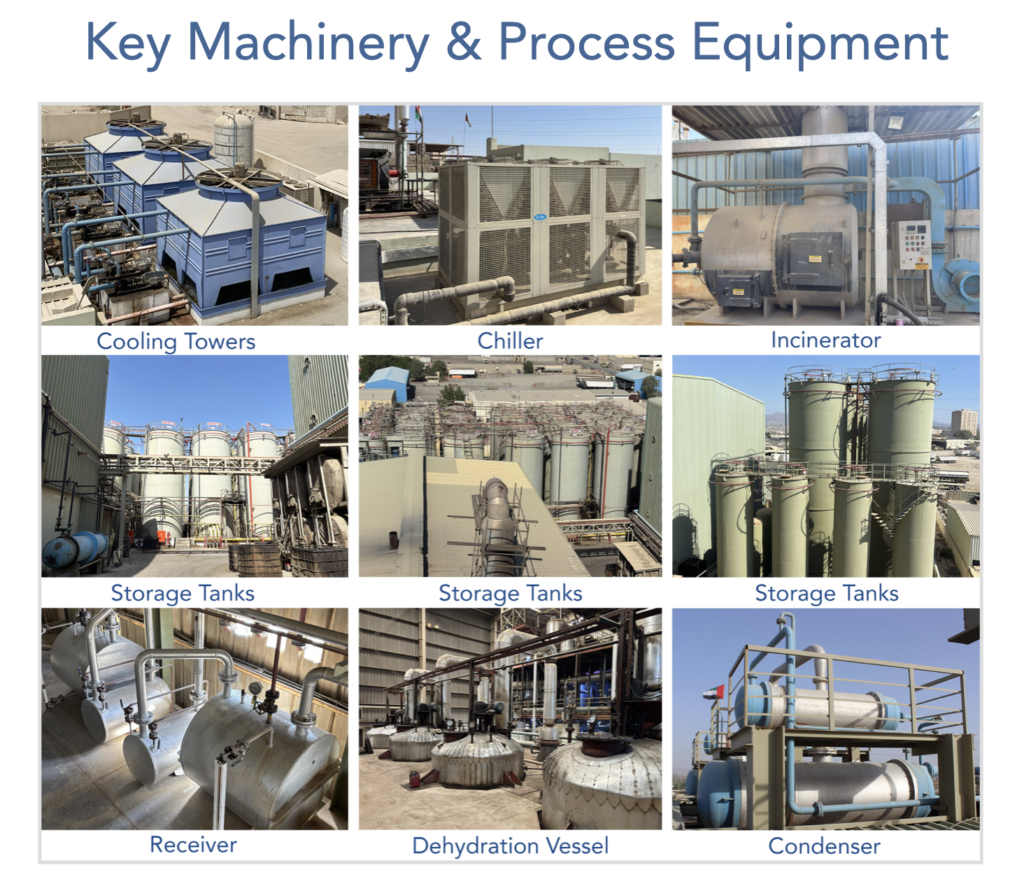
Controlled system: The process includes heating vessels, high-vacuum pumps, condensers, receivers, and internal circulation pumps.
The resulting distillate is clean and ready for further use after undergoing solvent polishing to enhance its clarity, color, and overall performance.
Technologies Used
For Used Engine Oils
(Polishing by Solvent Treatment (FFE) system)
Solvent treatment is the final polishing stage that enhances the purity, colour, odour, and performance characteristics of the base oil obtained from high vacuum distillation. Our facility uses a Falling Film Evaporator (FFE) system for this purpose.
Purpose of Solvent Polishing
Remove remaining impurities
Improve colour (from dark yellow to water-clear depending on process)
Reduce carbon and oxidation of the products
Increase stability and shelf life
Environmental Benefits
Minimal waste generation
Solvent recovery reduces emissions
Closed-loop treatment reduces hazardous impacts
Produces reusable, marketable base oil, contributing to UAE circular economy goals